I find the processes that cost time, measure what they cost in money, and build the solution that gives the time back.
The first time I did this there was no artificial intelligence involved: I rebuilt a manufacturing supply chain and cut the cost in half in under six months. In recent years I have been solving the same kind of problem with AI and automation platforms. In both cases the hard part is not the technology — it is the people who have to start working differently.
25 yearsof process management and system implementation inside organisations
5 systemsbuilt on my own — from process analysis to daily use
60–80 %time saved in the largest of them, measured stage by stage
Before artificial intelligence
The first process I rebuilt
Artificial intelligence is not what made me a process person. This is the case it started with — ten years before AI became a working tool at all.
Supply chain · institutional tenders
A manufacturing chain without middlemen
The company I worked for was registered as a metalworking and print manufacturer, but in practice it manufactured nothing itself. Production ran through a series of other companies, most of which were themselves middlemen to the actual manufacturers.
Why it became urgent
On a project to fit out a public building of national scale, costs rose above plan while the work was already under way.
Every middleman in the chain added a markup, and the final price no longer fitted the budget we had quoted.
Reorganising the company from within was not realistic — the shareholders were in different countries, and the decision path was far too long for a situation that needed action now.
What I did
I took the chain apart and rebuilt the process — each production step placed with the party that actually performed it, not with a middleman.
I contracted specialists directly instead of going through companies.
The result held after the project ended: the company became competitive in institutional tenders where its prices had previously ruled it out.
Ten years later the same process repeated itself with a different instrument. The bottleneck in this industry is artwork preparation — there are too few layout specialists, there is a queue, and the customer has no leverage over it. In the most recent case I waited three weeks on a manufacturer, only to find that production had not started because the layout specialist could not keep up. After that answer, an AI agent produced every layout in vector format from a written brief in 15 minutes. The queue disappeared; the work did not merely get faster.
Result
cut in halfmetalworking costs after the chain was rebuilt
< 6 monthsfrom spotting the problem to the result — the deadline was set by the project, not by a plan
2 manufacturersoutbid in a tender by Riga's municipal housing manager for building address plates; both with full in-house production
2 + 2a two-year contract, which the client then extended twice
Systems built
Five systems that are in use
For each one: the problem it solves, how it is built, and the measurable gain. Where there is a genuine “before” and “after” number, it is shown; where there is not, I have not invented one.
AI system · public procurement
IepirkumuAI
Preparation and review of public procurement documentation under Latvia's Public Procurement Law and the Law on the Procurement of Public Service Providers.
The problem
A single tender of average complexity takes 40–64 working hours of documentation and evaluation.
Documents are written by hand, copied from earlier ones; every legal reference has to be checked again from scratch.
An error in the documents leads to a complaint at the national Procurement Monitoring Bureau and suspension of the procedure.
How it is built
Four working modules and an 11-step procedure covering the full tender cycle, with a library of 40+ templates.
The legislation sits in the system as source files — legal references are taken only from those, never from the model's memory.
Automatic quality gates: if a check fails, the document is not released.
Missing fields are flagged and listed for a person to confirm, not filled in with assumptions.
Runs inside the institution's own environment or on AWS Bedrock / Google Vertex — the data never reaches a third party.
The system and its interface are in Latvian, because the legislation it works from is.
Before and after
Full tender cycle
before
after
40–64 h → 8–12 h of which specialist work itself — 3–4 h
Checking one bidder against registers
before
after
1–2 h → 10–20 min
Stage by stage
Tender regulations 16–24 h → 3–5 h Annexes 8–12 h → 1–2 h Evaluation criteria 4–8 h → 1 h Evaluation and minutes 12–20 h → 3–4 h
The register check module works with 15+ sources: the Business Register, the State Revenue Service, the Insolvency Register, the construction information system, sanctions lists, the EU Business Registers Interconnection System, VIES, GLEIF and foreign registers.
Work sample · one tender end to end
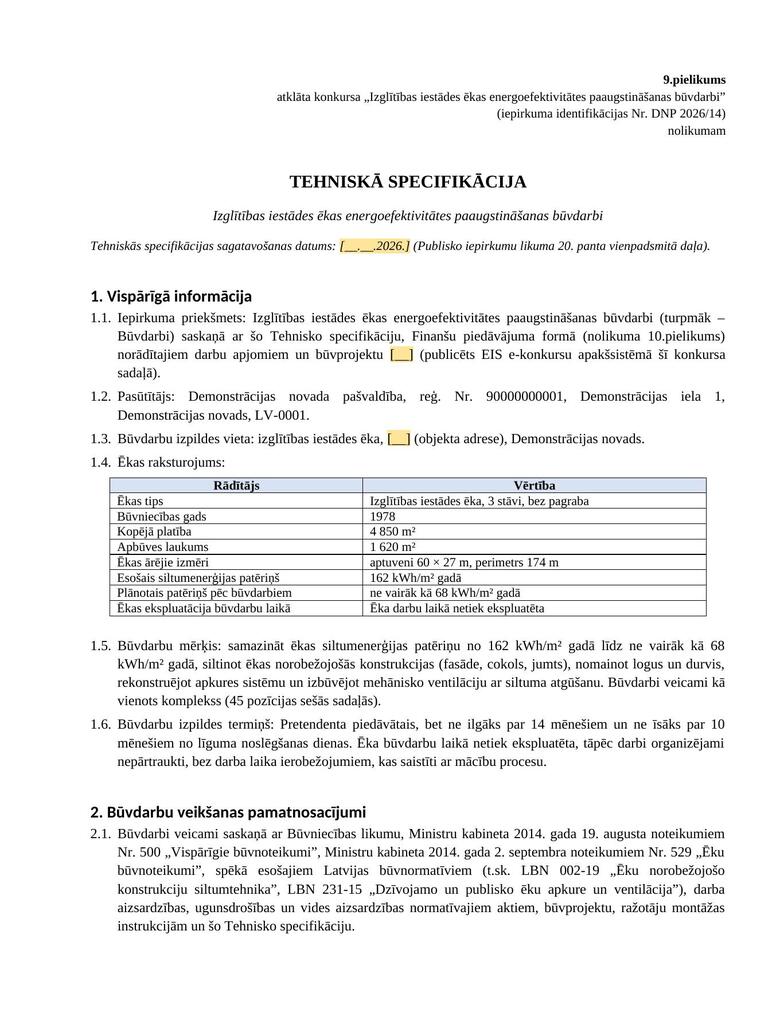
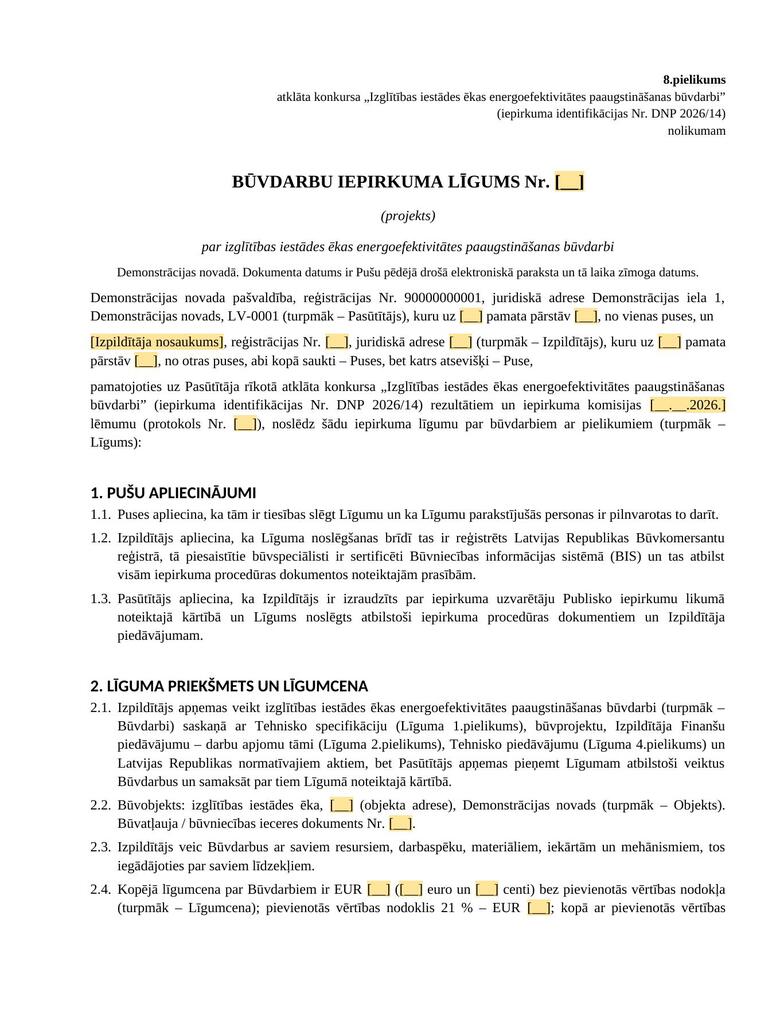
To show what this system actually produces, I wrote a fictional tender brief — energy efficiency construction work on a school, EUR 1,240,000 — and deliberately built five typical faults into it, of the kind that really do appear in tender documents. Below is what IepirkumuAI produced from it, and what it had to say about the brief itself.
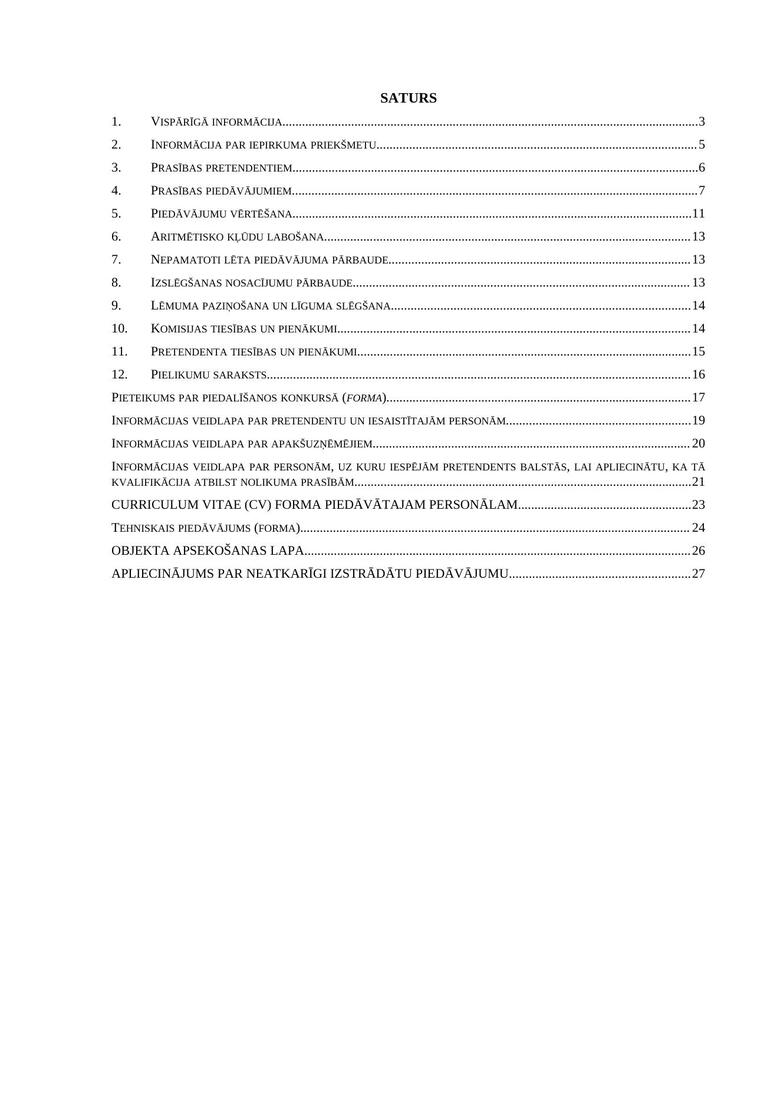
7documents in the full set — tender regulations with annex forms, technical specification, draft contract, bill of quantities, experience and personnel lists, work schedule
50pages of text, of which the tender regulations alone are 30 — plus the bill of quantities in Excel across three sheets
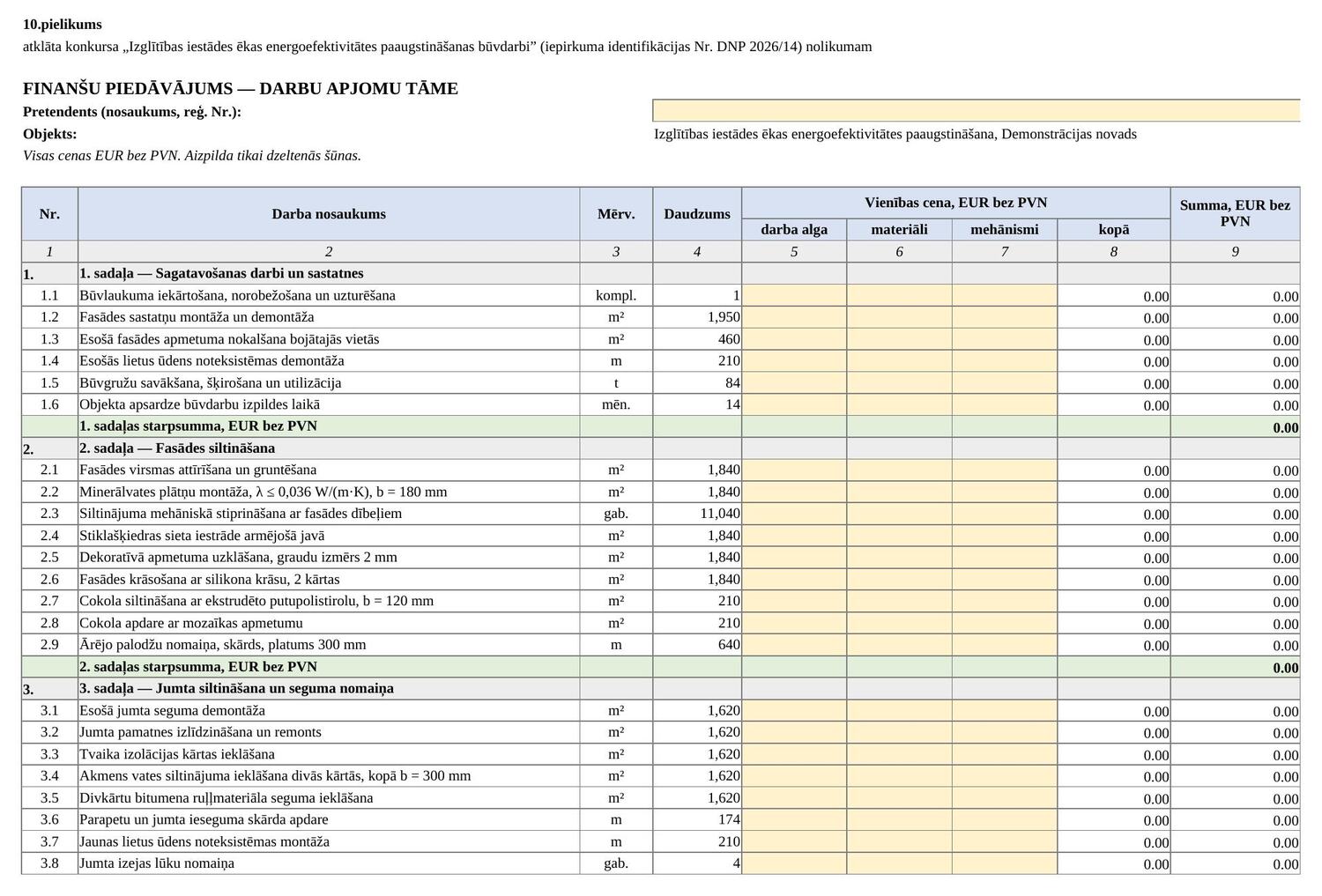
45line items in six sections, with protected formulas: subtotals, overheads, profit, VAT
Tender regulations — 12 sections and eight annex forms, 30 pagesTechnical specification — the building and the target: 162 → 68 kWh/m² per yearDraft contract — 16 sections; the yellow fields are the ones a person fills in
Financial proposal — 45 line items in six sections. The bidder fills in the yellow cells only: labour, materials and equipment. Unit price, line total, section subtotals, overheads, profit and VAT calculate themselves, and are protected against being overwritten.
What the system said about the brief
A disproportionate turnover requirement
in the brief
Average annual turnover of no less than EUR 5,000,000 — roughly four times the estimated contract value.
in the documents
EUR 2,480,000, citing Section 45(2) of the Public Procurement Law: no more than twice the contract value.
Grounds given in the analysis: Public Procurement Law, Section 45(2); Court of Justice of the European Union, Case C-218/11 Édukövízig and Hochtief. Risk level — high: disproportionate financial requirements are one of the most common grounds for a complaint to the Procurement Monitoring Bureau.
The other four were found the same way: a territorial experience requirement was removed (Sections 2 and 41(2); Supreme Court ruling SKA-1315/2016), a requirement for certificates issued in Latvia was replaced by a register check and recognition of foreign qualifications (Section 44(1)), the subjective criterion “bidder's reputation” was replaced by a measurable criterion with a point scale and a formula (Section 51(2)(3)), and an 18-day submission deadline was extended above the statutory minimum (Cabinet Regulation No. 107; Section 35).
The system also caught what I had not planted: the tax debt check sat in the wrong section of the regulations, the sample document I had used still referred to articles that have since been amended or repealed, the evaluation criterion for delivery time had no lower bound, and the tie-break procedure for equal bids had not been set in advance. All four are corrected in the documents and reasoned in the analysis.
The tender, the contracting authority, the building and every figure are invented. The set was prepared for demonstration — I do not show real client documents publicly, not even anonymised.
AI tool · document control
AI pre-check for procurement documentation
One upload, and a project's entire procurement documentation is checked against a full set of criteria, with each answer marked as settled, needing an expert, or needing a register lookup.
The problem
A project's procurement documents arrive in one pile; they have to be sorted by tender and each checked against a long list of criteria.
Done by hand this is repetitive work, and attention slips exactly where a mistake costs the most.
Risks that are only visible across all of a project's tenders at once — splitting a contract to stay under a threshold, for example — are not found at all when documents are checked one by one.
How it is built
The user uploads a whole project as a single ZIP file or as several Word files; the system groups them by tender and a person confirms the grouping.
Each tender is checked against a set of 157 questions with extracts from the law. The check runs in levels, and the next level starts only if the previous one passed.
Every answer is routed into one of three streams: answered automatically, needs expert judgement, needs a register lookup.
An aggregator looks at all of a project's tenders together and totals them against the statutory thresholds, to detect contract splitting.
The result downloads as a Word report; the data is deleted when the browser tab is closed.
The video shows a demonstration prototype: the tender regulations and draft contract in it are synthetic sample documents, not a real tender. The interface is in Latvian.
One real session
$2.29a full pre-check of three tenders — 362 AI calls
2–3 minrun time in batches, instead of days of manual work
157questions per tender, up to 168 AI calls
0 datanothing is retained once the session ends
Demonstration · 1 min 11 sFrom ZIP upload to finished report: automatic grouping, the check against 157 questions, the aggregator's contract-splitting analysis, and the routing of answers to an expert.
Web application · finance
InvoiceAI
An invoicing system for my own company: outgoing invoices, recognition of incoming invoices straight from the mailbox, and matching payments against the bank statement.
The problem
Incoming invoices arrive by email in various formats, and their data is retyped by hand.
Payments have to be reconciled against the bank statement manually, line by line.
Clients, products, outgoing invoices and reports live in separate files that do not talk to each other.
How it is built
React front end, Node/Express API and PostgreSQL; JWT authentication with data separated per company — one user can work across several.
An IMAP connection to the mailbox: the system collects invoices from email itself and reads them with AI, storing a confidence score for every recognised field.
Bank statement processing and automatic matching of payments to invoices by account number and amount; preparation of the payment file for the bank.
PDF invoice generation and sending, reporting, and voice input for quick entry.
In the demo every supplier, client and amount is invented. Invoice creation, bank statement import and payment matching work fully; mailbox reading and AI invoice recognition are deliberately switched off so that public access does not run up costs. The working version, which holds real company financial data, is not shown.
The essentials
Email → invoicethe system collects and reads invoices from the mailbox itself; manual entry disappears
Automatic matchingpayments from the bank statement find their own invoice
In daily usenot a prototype on a shelf — the system runs the company's day-to-day invoicing
No-code automation · service management
Social services management system
Clients, sessions, individual plans and assessments in one connected structure, with automatic reminders — built on existing platforms, with no development work.
The problem
Client records, the session schedule, individual plans and assessments live separately and do not talk to each other.
Reminders to clients and notices about schedule changes have to be sent by hand, so they get forgotten.
Producing a report means gathering the same information again every time.
How it is built
Five linked databases: clients, sessions, individual plans, assessments and staff — every record visible from all sides.
An intake form for new clients, a calendar view of sessions, and filtering by status instead of written reports.
Zapier and Make automations: email reminders to clients about sessions and notices about schedule changes.
Staff roles with different access levels — coordinator, specialist, administrator.
In the demo every client, staff member and record is invented. The real system, which holds client data, is not shown publicly. The demo content is in Latvian.
The essentials
5 databasesclients, sessions, plans, assessments and staff in one connected structure
Daysnot months — the tool matched to the size of the problem
€0development budget; platform subscriptions only
AI agent · publicity
Publication visual
Turns finished work — a folder, a set of documents, or the output of a chat — into a publishable visual in a Figma file, in three formats. It can be run from any project, including the output of another AI system.
The problem
When the work is done, it still has to be told about — and that means a separate job for a designer, with a brief, brand requirements and a place in the queue.
Three channels need three formats, and in each the content has to be different, not merely rescaled.
When publishing tender or project results, part of the information must not go out — and that is usually noticed at the last moment, or not at all.
How it is built
It reads the context itself and pulls out a headline, a summary and two to four key facts.
It sets the style itself: it finds the organisation's brand colours on its website, picks a palette and checks the contrast. Nobody writes a design brief.
A confidentiality gate: it publishes only what may be published — the final decision, the winner, the contract value, the deadlines. Internal evaluation, other bidders' proposals and personal data stay out, and the agent states exactly what it left out and why.
At the end it takes a screenshot of its own work and checks that the text is legible and nothing overlaps; if it is not, it fixes it before handing over.
It works through an MCP connection to Figma, and is packaged as a reusable skill rather than a one-off conversation.
The output is vector graphics, so the A4 format is meant for print and handouts rather than the screen — it scales without loss of quality. The formats are a setting, not a limit: the agent can be rebuilt for any size.
A person publishes, not the agent. The final sign-off — factual accuracy, confidentiality and visual quality — is given by a specialist. Legal responsibility stays in their hands.
ClaudeMCPFigmaskill packagingbrand research
This agent is built to work on the output of other systems. A tender prepared by IepirkumuAI becomes the input here: a publishable announcement comes out of a decision document with no step in between. That is also why the confidentiality filter sits in the agent rather than in someone's head — in tender documents, what may be published and what may not sit side by side.
Before and after
One publicity visual
before
after
4 h of manual layout work → a few minutes
2 → 0specialists to wait for: a lawyer to check the content and a designer to lay it out
3 formats1080×1080 for social media, 1200×630 for banners and A4 for print — in one file, with the content adapted for each rather than rescaled
A note on data
None of the links on this page lead to a system holding real data. Where a system works with a company's financial data or with client personal data, what is publicly available is a separate demo version with invented content. That is deliberate: an automation specialist sees more of a company's internals than almost anyone else, and a portfolio is not the place to demonstrate it.
Approach
How I work
01 — Starting point
I start with the process, not the tool
First I establish where the time goes and what it costs. Only then do I decide whether the answer is a Zapier scenario, an AI workflow or a separate application. The other way round usually ends in an impressive tool that nobody uses.
02 — Measurement
I measure the result in hours
Every solution has a “before” and an “after” number. It is the only way to prove that the automation paid for itself, and the only way to decide what to automate next.
03 — Trust
I do not trust AI blindly
In critical places the sources are files inside the system, the output is verified by a script, and what the system does not know is flagged rather than invented. Automation only pays off if the result does not have to be checked again from scratch — otherwise the time saved comes straight back.
04 — Finishing
I finish it into use
Most of my working life has been spent implementing systems in organisations where people have to start working differently. Building a prototype is quick; getting it still used in the third week is the real work.
Experience
Twenty-five years in processes
Before the AI solutions there was ERP and POS system implementation, project management and sales. That is the part which explains why the systems I build reach actual use.
2020 — present
Kasway · Founder, AI solutions developer
AI and automation solutions for documents and processes — from process analysis and prototype through to a working system and user training.
2023 — present
Riga East University Hospital · Consultant, client management processes
Designing the visitor flow concept and overseeing its implementation at one of the largest hospitals in Latvia.
2012 — 2023
LATSIGN · Project manager, municipal and key accounts
Infrastructure project management: budget, resources, cost control, risk and change management; teams of up to 10 people. Public tender submissions through the national e-procurement system.
2011 — 2012
ERP PRO · Sales project manager
Contract with a 170-store retail chain and the sales control and analytics system built for it. MS Dynamics AX/NAV, QlikView.
2008 — 2010
Biznesa Pamati · Founder and director
An accounting services company built from nothing: internal processes, contract delivery control, team. The company was later sold and is still trading today.
2002 — 2007
Ankravs · Project manager
ERP and POS system development and implementation projects. Exclusive representative in Latvia for Nordic ID warehouse tracking solutions.